DTCP & RERA Approved Plots Near Bharath Future City – What Every Serious Investor Must Know in 2026
Key takeaways
- DTCP plus TG RERA is still the baseline, but layout approvals inside Future City now sit with FCDA, so older approvals need a check.
- Ask for the LP number, sanction date and authority, then verify on the portals and get a lawyer's note.
- Compare layouts by approval, road access and developer record before price.
Updated 30 September 2026: added the FCDA approval note, fixed broken internal links and expanded the FAQ.
If you've been tracking Hyderabad's real estate market seriously, you already know that the city's biggest wealth creation events — HITEC City, the Financial District, Pharma City — all followed a predictable pattern. Government announces a large infrastructure or development zone. Smart money quietly buys land within or adjacent to that zone. The zone develops over 7–10 years. Early buyers see returns that casual observers can barely believe. Bharath Future City is the current chapter of that story. And right now, in mid-2026, the entry window is still open — but not for much longer.
This guide is written specifically for long-term investors — people who understand that meaningful land appreciation takes time, who want to enter legally and cleanly, and who are serious enough to do their homework before committing capital. We'll walk you through what DTCP and TG RERA approvals actually mean, why they matter more in this corridor than anywhere else, and what to specifically look for when evaluating a plot near Bharath Future City.
First — What Is Bharath Future City and Why Should Investors Care?
Bharath Future City (officially referred to as Future City Telangana or Hyderabad Future City 4.0) is a 30,000-acre Net-Zero Greenfield Smart City being developed between the Srisailam Highway (NH-765) and Nagarjuna Sagar Highway by the Future City Development Authority (FCDA) — a statutory body set up by the Telangana State Government. This is not a private developer's vision. It's a government-backed, authority-governed, master-planned urban zone with a Concept Master Plan prepared by Surbana Jurong for Telangana Industrial Infrastructure Corporation Ltd.
The scale is what makes this extraordinary. The core zone alone spans 13,973 acres across multiple planned land use divisions — 4,774 acres for Electronics & General Industries, 4,207 acres for Life Science Hub, 1,317 acres for Residential & Mixed Use, 454 acres for Educational & University zones including the Young India Skill University, 297 acres for AI City, 370 acres for Health City, and 761 acres for a Sports Hub. Surrounding this are private-sector anchors already committed: an Amazon Data Center campus of 48 acres, Eliminedu Aerospace SEZ covering 2,000 acres, Foxconn Manufacturing facilities, and the proposed 330-ft wide Ratan Tata Greenfield Road connecting from the Outer Ring Road (Raviryala, Exit 13) through the Future City zone.
The zone is bounded to the south by the Outer Ring Road (ORR) and to the north by the proposed Regional Ring Road (RRR) — a 1,712-km, 60-road network currently under phased development. Being between these two ring roads with two national highways running through is not incidental geography — it's the infrastructure backbone that makes this zone viable for the kind of development planned.
For investors, the question isn't whether Bharath Future City will develop. The question is: are you positioned inside the zone before prices reflect what's coming?
Why DTCP and RERA Approvals Are Non-Negotiable in This Corridor
The Bharath Future City corridor is attracting a lot of attention — which unfortunately also attracts a lot of unapproved layouts being marketed with misleading claims. If there was ever a location in Hyderabad where verification of approvals is absolutely critical, this is it. Here's why these two approvals matter so much.
What DTCP Approval Actually Means
DTCP stands for Directorate of Town and Country Planning — the Telangana government authority that approves residential layouts outside the HMDA zone. A DTCP Final Approved Layout means the government has reviewed the layout plan, confirmed the survey numbers, verified the land use classification, checked for encumbrances, and approved the roads, open spaces, and plot dimensions. It is not a provisional clearance — it is a final sanction.
Critically, a DTCP approved layout carries a T.L.P. Number (Town Layout Planning Number) that you can independently verify with the DTCP office or their online portal. If a developer cannot give you a real TLP number, or if that number is "applied" rather than "final approved," walk away. The difference between a pending application and final approval is enormous — only final approval allows legal plot registration. If you're unsure how to check this yourself, our step-by-step guide to verifying DTCP approvals explains exactly what to look for.
What TG RERA Registration Means for Investors
RERA (Real Estate Regulatory Authority) registration under Telangana's RERA Act is an additional layer of protection that became mandatory for real estate projects above a threshold size. A TG RERA registration means the developer has submitted project details, financial disclosures, approval documents, and delivery timelines to the regulatory authority — and is legally accountable under RERA for delivering what was promised.
For investors specifically, TG RERA registration means two things that matter. First, the project documents are publicly verifiable on the RERA portal — you can confirm the approval numbers, the promoter's details, and the project specifications without depending on the developer's marketing materials. Second, if there's a dispute, RERA gives you a formal legal mechanism for resolution that doesn't require expensive civil litigation. Our guide on how RERA protects your real estate investment goes deeper into both of these protections.
Why Both Approvals Together Create the Strongest Position
A plot with DTCP final approval has legal sanction for the layout. A plot with TG RERA registration has regulatory accountability for the developer. Together, they create the most legally secure entry position available in this market. Both verify independently. Both can be confirmed through government portals before you spend a rupee. This dual-approval structure is exactly what serious investors should demand — and frankly, should refuse to compromise on in any corridor, especially one as high-profile as Bharath Future City.
✅ Investor's Approval Verification Checklist
- ✓DTCP Final Approval: Ask for the T.L.P. Number. Verify directly at dtcp.telangana.gov.in
- ✓TG RERA Registration: Ask for the RERA Number. Verify at rera.telangana.gov.in
- ✓Survey Numbers: Cross-check Sy. No. with the local Sub-Registrar or MeeSeva portal
- ✓EC (Encumbrance Certificate): Verify the land has no loans, mortgages, or disputes attached
- ✓Clear Title: Confirm 30-year title history through a lawyer before registration
- ✓Spot Registration: The ability to register immediately is a sign of clean documentation
- ✓Bank Loan Availability: Banks do their own due diligence — loan approval confirms the project passes basic legal checks
Where Exactly to Buy: The Nandiwanaparthy Opportunity
Within the broader Bharath Future City corridor, Nandiwanaparthy — located in Yacharam Mandal, Rangareddy District — has emerged as one of the most well-positioned locations for plot investment. The village falls inside the official Future City Development Authority (FCDA) boundary, which means land here is directly within the governed development zone, not merely adjacent to it. That's a meaningful distinction for investors evaluating appreciation potential.
The specific coordinates matter too. Nandiwanaparthy sits between the Nagarjuna Sagar Highway to the west and the Srisailam Highway to the east — the exact two national highways that form the spine of the Future City zone. It's roughly equidistant from both, placing it at the geographic centre of the development zone rather than on its periphery. The 330-ft Ratan Tata Greenfield Road running through this corridor will, when complete, directly improve connectivity from Nandiwanaparthy to the ORR and onwards to Hyderabad's urban core. To understand the full connectivity picture, our detailed Nandiwanaparthy location guide covers every major road, distance, and infrastructure project with specifics.
JRR Royal Imperia — The Only DTCP & TG RERA Approved Layout at Nandiwanaparthy
JRR Royal Imperia by Kubera Realty is a DTCP and TG RERA approved gated community of residential villa plots at Sy.No. 910/P, 911/P, Nandiwanaparthy Grampanchayat, Yacharam Mandal, Rangareddy District. The DTCP approval numbers are T.L.P.No. 127/2021/H and T.L.P.No. 01/2023/DTCP/RR, with TG RERA registration P02400010783. These are not marketing claims — they are government-issued reference numbers you can verify independently today.
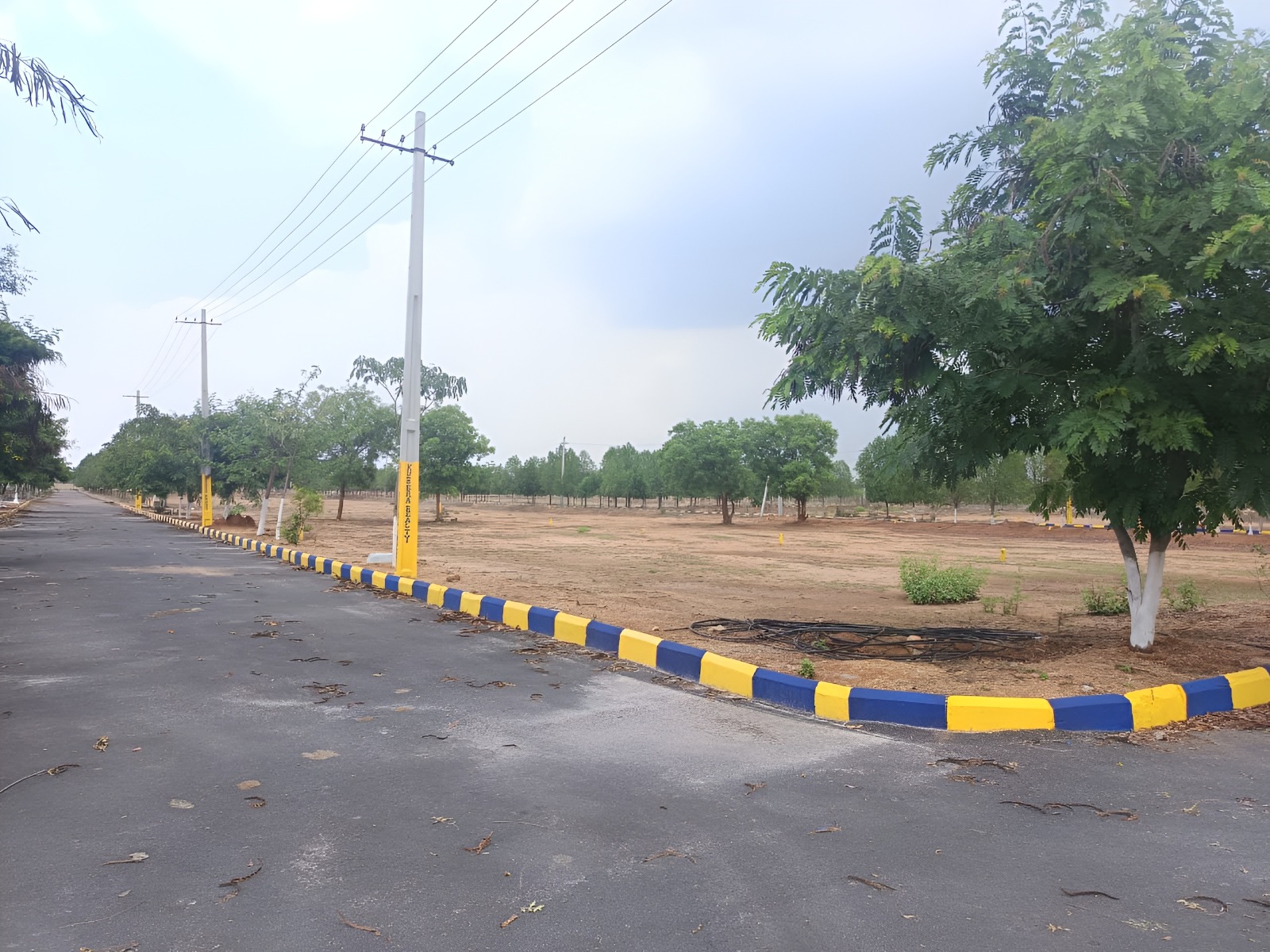
The project has 69 plots ranging from 220 to 238 square yards, priced at ₹13,500 per square yard. With bank loans available and spot registration in place, the entry process is clean and fast. The layout is fully developed — 40 ft and 33 ft blacktopped roads, underground drainage, overhead water tank, street lights, entrance gate, and landscaped greens. You're not buying into a promise of infrastructure — it's already built. You can check current plot availability and browse the project gallery to see site photos.
The Investment Case: How Serious Investors Should Think About This
Let's be direct about the risk-return profile here — because serious investors deserve that, not just optimistic marketing.
The Bull Case
If Bharath Future City develops even 40–50% of what the master plan envisions over the next 10 years, land within the FCDA zone will be in significantly higher demand than it is today. The precedents are clear — the ORR corridor saw land prices multiply several times over a decade as development materialised. The Pharma City zone in Mucherla followed a similar trajectory. The ingredients that drove those corridors — government authority, large-scale infrastructure, private sector anchors, and connectivity — are all present here. The Amazon Data Center alone is a 48-acre commitment that signals serious private confidence in the zone.
The Risk to Acknowledge
Government mega-projects in India routinely take longer than announced timelines. If you need your capital back within 3 years, this is not the right investment. The Bharath Future City development will be phased across a decade or more. Plot values may not show dramatic appreciation in years 1–3. The investor who entered the ORR corridor in 2008 waited several years before seeing meaningful appreciation — but those who held through 2015–2018 saw extraordinary returns.
The honest position: if you can commit capital for 7–10 years with no requirement for liquidity in the interim, the risk-return here is genuinely compelling. If you need shorter-term gains, look elsewhere. Also compare against our farmlands investment guide along the RRR corridor if you're evaluating alternatives in the broader Hyderabad outskirts market.
Why DTCP and RERA Approval Reduces Risk Significantly
The single biggest risk in buying plots near any large development zone is landing in an unapproved or disputed layout. These layouts get demolished, litigated, or simply frozen when development authority jurisdiction is asserted. A DTCP-approved layout with TG RERA registration has already passed government scrutiny — it is legally in the system, it can be registered, and your ownership is recorded in government records. That's the difference between speculation and structured investment.
Ready to Evaluate This Investment Seriously?
The best next step for any serious investor is a site visit — see the location, walk the layout, understand the surrounding zone. Our team at Kubera Realty can also walk you through all approval documents in person.
How to Compare Plots in This Corridor — An Investor's Framework
If you're evaluating multiple plots or layouts near Bharath Future City, here's the framework serious investors should apply before committing:
- Approval status first, everything else second. Does the layout have DTCP final approval with a real T.L.P. number? Is it TG RERA registered? If either is missing or unverifiable, stop the evaluation there. The Bharath Future City corridor will have many semi-approved and unapproved layouts marketed aggressively. Don't compromise here.
- Survey number and EC verification. Get the survey number of the specific plot and run an Encumbrance Certificate check through MeeSeva. This will show you if the land has been pledged as loan collateral, has any court orders, or has ownership disputes. This is non-negotiable due diligence.
- Position within the FCDA boundary vs. adjacent. Not all land near Bharath Future City is inside the FCDA zone. Land inside the boundary is under FCDA authority and is directly in the development footprint. Land outside but adjacent may still benefit from spillover, but it's a weaker position. Verify on the published FCDA boundary map.
- Developer track record. In a corridor with this much attention, new and inexperienced developers will enter the market. Buy from a developer with completed previous projects that buyers have actually taken possession of. Visit past projects, speak to actual buyers. Read about Kubera Realty's 20+ year track record and their other completed projects across Hyderabad.
- Price per square yard relative to location within the zone. At ₹13,500 per sq. yd for a DTCP and TG RERA approved layout inside the FCDA boundary, the JRR Royal Imperia pricing reflects early-stage entry — not peak pricing. As infrastructure materialises and more buyers enter the market, this price floor will move. The question for any investor is whether you want to be the one who bought before that move or after.
- Fill the customer application and register the plot through the developer's proper process. Avoid side deals or informal bookings. Use the official customer application form and ensure your name is on a government-registered sale deed before any money changes hands.
What changed when FCDA took over approvals
When the Future City Development Authority became operational, layout and building approval powers within its boundary moved to it from HMDA and DTCP, as Deccan Chronicle reported. That doesn't make an earlier DTCP approval worthless, but it does mean "DTCP approved" is no longer the end of the question. Ask when the approval was granted, what the sanction covers and how the layout stands under the current authority, and get the answer in writing from a property lawyer.
We explain the portal checks in our approval verification guide, and our guide to future city plots in Hyderabad for sale sets out the complete buying process. To confirm your village is inside the boundary, use the Future City villages list.
The Bottom Line for Long-Term Investors
Bharath Future City is the most significant planned urban development in Hyderabad's growth story since HITEC City. The FCDA boundary has been drawn, the master plan has been published, the private sector anchors are committing, and the road infrastructure — including the RRR and the Ratan Tata Greenfield Road — is progressing. For long-term investors who understand that land within government-backed development zones compounds quietly before it compounds dramatically, the Nandiwanaparthy corridor inside the FCDA boundary is as strong a positioning as exists near Hyderabad today.
But the advantage belongs to those who enter while the price still reflects the present, not the future. DTCP and TG RERA approved plots with clear title and spot registration inside this zone, at ₹13,500 per sq. yard, represent an entry point that will not be available once the zone's development becomes visible to the market at large. The question isn't whether to be in this corridor — it's whether you want to be in it at today's price or at tomorrow's.
If you're ready to take the next step, book a free site visit to JRR Royal Imperia. See the location, verify the documents, and make your decision with complete information in front of you — not from a brochure.
Want us to check a specific layout with you?
Send us the LP number and survey number. We will tell you what the records show, including when the answer is "we can't confirm this one".
Frequently Asked Questions
Are there DTCP and RERA approved plots near Bharath Future City?
Why do DTCP and RERA approvals matter when buying plots near Bharath Future City?
What is the investment horizon for plots near Bharath Future City?
What is the minimum investment for plots near Bharath Future City?
Is Nandiwanaparthy inside the Bharath Future City zone?
How can I verify DTCP and RERA approvals for plots near Bharath Future City?
Is Bharath Future City actually going to happen?
Did FCDA replace DTCP and HMDA approvals near Future City?
Sources and further reading
- FCDA now fully operational (Deccan Chronicle) – approval powers devolved to FCDA
- Telangana RERA – verify a project's registration
- HMDA DPMS public search – verify HMDA layout permission
We link to official portals and news reports so you can check the facts yourself. Broker and developer pages are marked nofollow and cited only for price quotes, which are asking rates rather than registered sale values.