Nandiwanaparthy Location Advantages – Connectivity, Infrastructure & Future Plans Explained for First-Time Buyers
Key takeaways
- Nandiwanaparthy is in Yacharam mandal, inside the 56-village Future City area.
- A new 8 km road from Takkellapalli via Kurmidda and Tatiparthi is under construction.
- Judge the location by roads that exist today, then by plans.
Updated 30 September 2026: added the new road update and links to the village list and area comparison.
If you're seriously considering buying a plot near Hyderabad for the first time, you've probably been told to "look at the location carefully." But what does that actually mean in practice? In this guide, we'll break down exactly what makes Nandiwanaparthy stand out — not in vague marketing language, but in concrete, factual terms: roads, distances, government projects, and the infrastructure either already in place or firmly on the roadmap.
By the end of this article, you'll have a clear picture of whether this location matches what you're looking for — whether you plan to build a home here or hold the land as a long-term investment.
Where Exactly Is Nandiwanaparthy?
Nandiwanaparthy or Nandi Wanaparthy is a village in Ranga Reddy district in Telangana, India. It falls under Yacharam mandal, located in the growth corridor between two of Hyderabad's most important highways — the Srisailam Highway (NH-765) and the Nagarjuna Sagar Highway (NH-565). This placement between two national highways isn't a coincidence; it's one of the primary reasons the Telangana government chose this belt for its most ambitious urban development project to date.
In terms of distance, the area sits roughly 70–80 km from Hyderabad's city centre and is accessible from multiple directions. For first-time buyers, this kind of buffer from the city is actually an advantage — you're buying land that hasn't yet been priced like prime urban real estate, but is directly in the path of planned urban expansion.
Road Connectivity: What's There Today
Srisailam Highway (NH-765)
This is the primary highway connecting Hyderabad to Srisailam and beyond into Andhra Pradesh. Nandiwanaparthy falls within accessible distance of this corridor, which means residents can reach the city without depending on narrow state roads. The NH-765 has seen significant upgrades in recent years — it's a proper four-lane national highway for most of its stretch, making the commute far more practical than it might sound on paper.
Nagarjuna Sagar Highway (NH-565)
The second major artery in this belt, NH-565, connects Hyderabad to Nagarjuna Sagar and runs parallel to the Srisailam highway through this region. Having two national highways flanking a growth corridor means road-based connectivity from multiple directions — which matters a lot if you're thinking about daily commutes or accessibility for guests and workers when you eventually build.
State and District Roads
Beyond the national highways, the district road network connecting Nandiwanaparthy to nearby towns like Miryalaguda, Bhongir, and Yacharam Mandal is functional. These aren't premium expressways, but they're workable — and importantly, as Bharath Future City development ramps up, this internal road network is expected to see substantial upgrades as part of the project's infrastructure mandate.
📍 Approximate Distances from Nandiwanaparthy
- 🏙️ Hyderabad City Centre (Nampally): ~75 km via NH-765
- ✈️ Rajiv Gandhi International Airport (Shamshabad): ~80 km
- 🏛️ Ranga Reddy District HQ: ~40 km
- 🏥 Miryalaguda (nearest large town): ~25 km
- 🏗️ Bharath Future City (proposed core zone): In direct proximity
- 🔬 Hyderabad Pharma City (Mucherla): ~50 km
The Bharath Future City Connection — Why This Changes Everything
For a first-time buyer, it can be hard to grasp the scale of Bharath Future City. So let's put it simply: this is the Telangana government's plan to build an entirely new city from scratch — 30,000 acres, designed to house nearly 30 lakh people, attract global corporations, and become India's first Net-Zero smart city.
The project sits between the Srisailam and Nagarjuna Sagar highways — the exact corridor where Nandiwanaparthy is located. It includes plans for:
- Global tech and AI innovation parks — designed to attract companies in sectors like artificial intelligence, fintech, pharmaceuticals, and advanced manufacturing
- Metro rail connectivity — extensions from Shamshabad Airport into the new city zone are part of the long-term transport plan
- Dedicated expressway links — new road infrastructure connecting the smart city to Hyderabad's existing ring roads and expressways
- Educational and healthcare campuses — international schools, universities, and multi-specialty hospitals are part of the master plan
- Utilities and smart infrastructure — integrated water supply, sewerage, fibre internet, and power grid systems built from the ground up
When a project of this magnitude is announced and begins receiving government funding, land in its immediate vicinity typically appreciates before a single building goes up. That's not speculation — that's the documented pattern from every major infrastructure project in Hyderabad over the past two decades, including the HITEC City corridor, the Financial District, and the Pharma City zone. For a detailed analysis of this pattern, see our piece on emerging real estate corridors in Hyderabad.
Existing Infrastructure in and Around Nandiwanaparthy
One concern first-time buyers often have is: "Is there anything actually there right now, or am I buying into a field?" It's a fair question. Here's the honest picture.
What Exists Today
Nandiwanaparthy is a functioning village with basic civic amenities — electricity supply, water infrastructure, a local school and healthcare centre, and retail access for daily needs. The nearby town of Miryalaguda (roughly 25 km away) serves as the larger service hub for the region, with hospitals, banks, markets, and government offices.
The key point is this: the area is not barren or undeveloped — it has the baseline infrastructure of a functioning community. What it doesn't yet have is the premium urban infrastructure that will arrive with Bharath Future City. That gap is precisely what creates the investment opportunity.
Layout-Level Infrastructure at JRR Royal Imperia
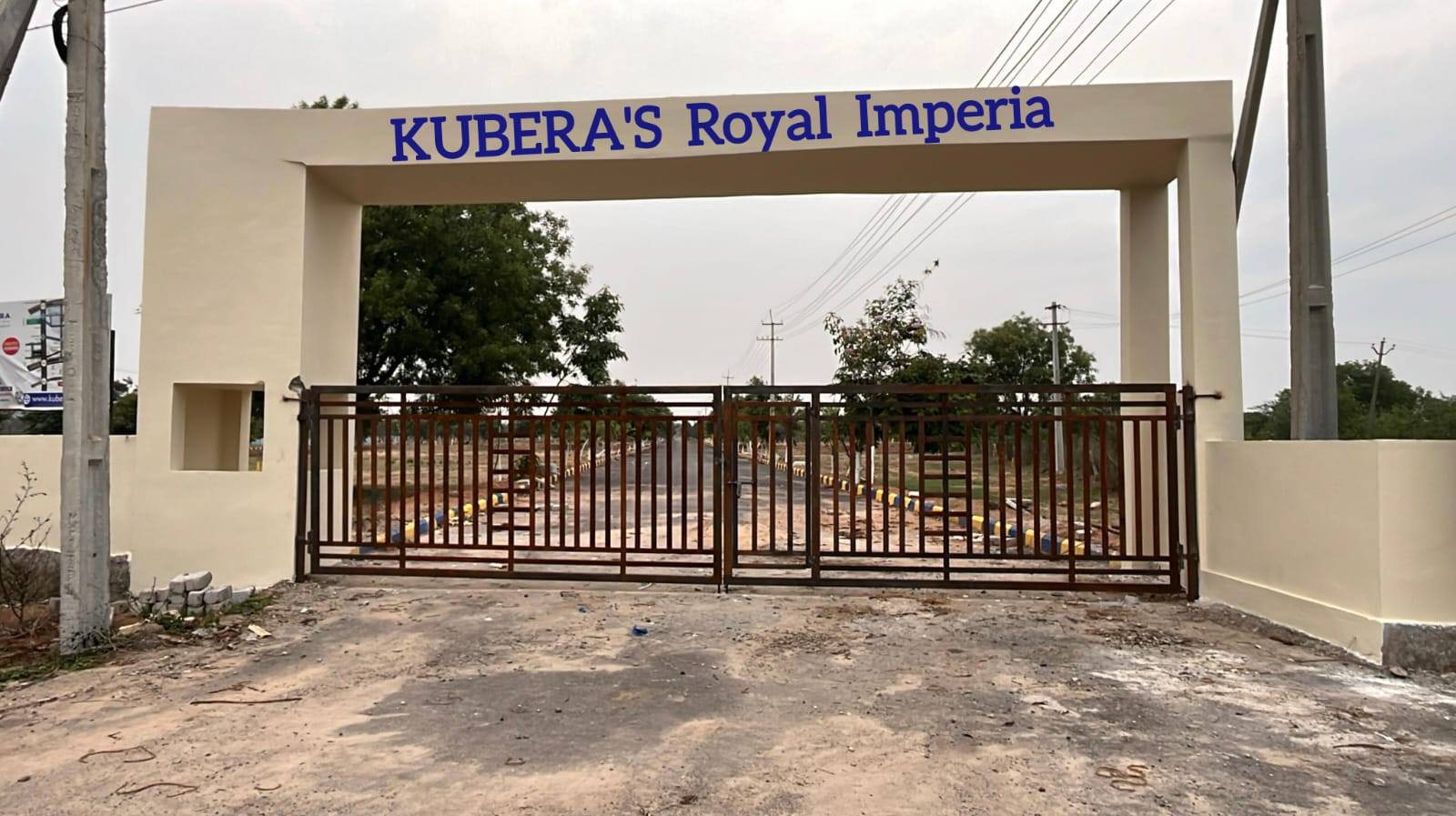
Within the JRR Royal Imperia plotted layout by Kubera Realty, the infrastructure question is already answered. The layout comes with an overhead water tank, underground drainage, water supply lines, wide blacktopped internal roads (40 ft and 33 ft), and a finished entrance gate. This means you're not waiting for the developer to build out amenities — it's done. You can view the site gallery here to see current on-ground conditions.
Future Infrastructure: What's Planned and When
This is the section first-time buyers need to read carefully. Planned infrastructure is not the same as completed infrastructure — and it's important to understand the difference before making a purchase decision.
Bharath Future City (Government-Backed, Long-Term)
This is a 10–15 year development horizon. Don't expect a metro station outside your door in three years. What you can reasonably expect is progressive land value appreciation as the project receives funding, as companies announce their presence, and as supporting infrastructure like roads and utilities gets built out in phases. If you're buying with a 7–10 year view, you're buying at the beginning of that cycle.
Road Upgrades
The Telangana government has historically upgraded road infrastructure in corridors where large development projects are announced. The NH-765 and NH-565 upgrades have already been underway. Internal roads connecting the Bharath Future City zone to surrounding areas are expected to be prioritised in the project's early phases.
Metro and Mass Transit
The metro extension plans are real — but they're also long-term. Phase-wise implementation means outer areas typically get connectivity in later phases. For a buyer today, metro connectivity at this location is a 10+ year expectation. That said, once it arrives, the impact on land values in the area tends to be significant and fast.
First-time buyer tip: When evaluating a location like Nandiwanaparthy, separate "what exists today" from "what's planned." Make sure you're financially comfortable with the current state of the area — because the planned improvements are a bonus, not a guarantee on any fixed timeline. If the location works for you as it is today, the future upside is simply additional.
Livability Today: Is This a Place You Can Actually Live In Now?
If you're buying to build a home and move in within the next 1–2 years, here's the honest picture of daily life in this corridor today:
Daily Needs and Services
For groceries, medical care, banking, and schools, residents currently depend on nearby towns — primarily Miryalaguda and to some extent Bhongir. This is standard for any developing area at this distance from a major city. It's comparable to how areas like Shadnagar or Chevella looked 10 years ago before they developed their own service ecosystems.
Air and Environment
One often overlooked advantage of areas at this distance from Hyderabad is air quality and open space. If you've lived in the city through the summer and monsoon, you'll know the value of lower density and greener surroundings. For families with children or elderly members, this is a genuine quality-of-life benefit.
Water and Power
The region is covered under Telangana's water supply grid, and electricity supply in this corridor has improved substantially over the past few years. Within JRR Royal Imperia, the overhead tank and underground drainage systems ensure plot owners aren't dependent solely on civic infrastructure.
How to Think About This as a First-Time Buyer
Buying land for the first time is different from buying a flat. With a flat, you're buying something complete — you can move in and the developer has handled everything. With a plot, you're buying potential — and the job of converting that potential into reality (building a house, connecting utilities, landscaping) eventually falls to you.
Here's a simple framework for evaluating whether Nandiwanaparthy is right for you:
- Timeline: Are you comfortable holding this land for at least 5–7 years before expecting significant appreciation? If yes, the location fundamentals are strong.
- Purpose: Are you buying to build a home, or purely as an investment? If building, plan your construction timeline around current service availability — not future plans.
- Legal clarity: Always buy from DTCP or HMDA approved layouts with clear titles. This is non-negotiable. Our guide on how to verify DTCP and HMDA approvals tells you exactly what to check.
- Developer track record: Buy from a developer who has completed previous projects. Visit their past layouts and speak to buyers if possible. Read about why buyers choose Kubera Realty for this kind of due diligence.
- Budget fit: At ₹13,500 per sq. yard with bank loan availability, the entry ticket at JRR Royal Imperia is realistic for most first-time land buyers. Don't stretch beyond your comfortable EMI capacity.
A September 2026 road update
A Siasat report from 26 September 2026 says the government is building an 8 km road from Takkellapalli on the Hyderabad–Nagarjunasagar highway through Kurmidda and Tatiparthi, at about ₹30 crore, to serve industrial traffic. Both villages are neighbours of Nandiwanaparthy. It doesn't change the need to check access to your specific plot, but it is the kind of concrete work we'd rather point to than announcements. To see how the village compares with others, read our guide to future development areas in Hyderabad, then the villages list and price guide.
The Bottom Line on Nandiwanaparthy's Location
Nandiwanaparthy today is a location in transition — not a fully-formed urban zone, but not an empty field either. It sits at the intersection of two national highways, within the direct footprint of India's most talked-about new smart city project, and at a price point that still makes sense for first-time buyers entering the land market.
The connectivity story is real — two national highways today, with metro and expressway links planned as Bharath Future City takes shape. The infrastructure within approved layouts like JRR Royal Imperia is already complete. And the future plans, while long-term, are government-backed at a scale that gives them credibility.
If this matches your investment horizon and you're ready to see the area for yourself, the most useful next step is a site visit. Seeing the location in person — the roads, the surroundings, the layout — will answer any remaining questions better than any article can.
Ready to See Nandiwanaparthy for Yourself?
Our team at Kubera Realty arranges free, no-obligation site visits to JRR Royal Imperia. See the roads, the layout, and the surrounding area before making any decision.
Want us to check a specific layout with you?
Send us the LP number and survey number. We will tell you what the records show, including when the answer is "we can't confirm this one".
Frequently Asked Questions
How far is Nandiwanaparthy from Hyderabad?
Which highways connect Nandiwanaparthy to Hyderabad?
What is Bharath Future City and how does it relate to Nandiwanaparthy?
Is Nandiwanaparthy suitable for first-time plot buyers?
Will there be metro connectivity in Nandiwanaparthy?
What infrastructure is available inside the JRR Royal Imperia layout at Nandiwanaparthy?
Is Nandiwanaparthy part of the Future City area?
Is there any recent road work near Nandiwanaparthy?
Sources and further reading
- Siasat: new road to link Bharat Future City – road from Takkellapalli
- Telangana Today: metro corridor survey – proposed metro alignment
We link to official portals and news reports so you can check the facts yourself. Broker and developer pages are marked nofollow and cited only for price quotes, which are asking rates rather than registered sale values.